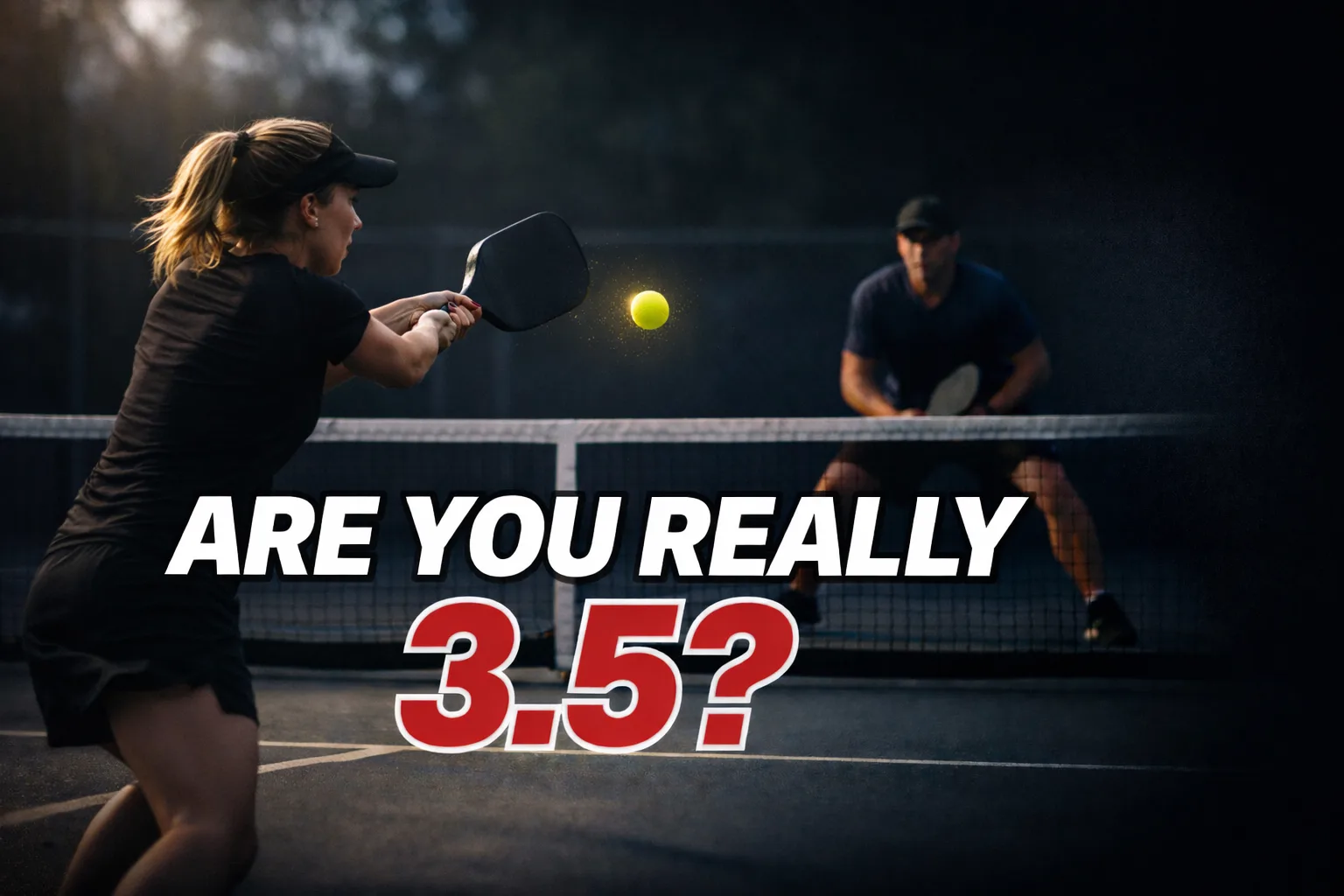
If you play pickleball regularly, you’ve probably heard people describe themselves as a 3.5 player. It’s one of the most common ratings in recreational play, and also one of the most abused labels.
Some people use “3.5” to mean “I can hit hard.” Others use it to mean “I beat my buddies.” Neither is a rating system. The practical divider between 3.0 → 3.5 → 4.0 is usually consistency + decisions under pressure, not highlight-reel shots.
That’s why Pickleball IQ (PIQ) exists: it checks whether you actually understand when to do what — drops vs drives, resets vs counters, when to move up, when to hold the line.
👉 Want to confirm your real level (without arguing at open play)?
Take PIQ: Pickleball IQ
What 3.5 players do well
At 3.5, most players have real structure in their game. You’re not just “hitting it back.” Typical strengths:
- Serve + return are playable (less free points donated)
- Basic third-shot awareness (you know drops exist for a reason)
- Comfort at the kitchen (dinks can go more than 2 shots)
- Better court geometry (you’ve discovered crosscourt is a thing)
- Some shot variety (drive, drop, dink, occasional lob)
In short: you’re starting to play pickleball, not paddleball.
What 3.5 players typically struggle with
This is where 3.5 gets spicy: you know the “right” play, but the ball doesn’t always cooperate.
Third-shot drop inconsistency
Most 3.5 players attempt drops. Many of those drops are… ambitious.
Common patterns:
- too hard → sits up → gets punished
- too short → lands in the net
- “drop” turns into a drive with plausible deniability
If this is you, it’s normal. It’s also the biggest lever to reach 4.0.
Helpful next reads:
Transition zone chaos
A classic 3.5 move: sprinting to the kitchen like the line is on fire.
Problems:
- hitting while moving
- getting caught mid-court with a floating ball
- popping up “easy mode” attack balls
Good players don’t rush the kitchen. They arrive at the kitchen.
Resetting fast balls
When opponents drive harder, many 3.5 players default to:
- big swings (in the transition zone, no less)
- trying to counter everything
- popping balls up because the paddle face is having a moment
Resetting is boring. It’s also how you stop losing points you “shouldn’t” lose.
Over-investing in “advanced” shots
Roll volleys, flicks, spin serves, ATP attempts.
Not saying don’t learn them. Just know the trade: most 3.5 players would gain more rating by improving two boring things:
- drop quality
- reset quality
The most failed PIQ gates at 3.5
PIQ is built around the reality that players can look solid in drills and still make consistently bad choices in games.
The most common decision failures around 3.5:
- Moving up at the wrong time (especially after serving)
- Attacking balls that should be reset (ego tax)
- Dropping while off balance (drop quality collapses)
- Targeting the wrong opponent (hitting to the better player because “they’re there”)
These aren’t “form” problems. They’re game-reading problems.
If you want a fast check on whether your decisions match your self-rating: 👉 Take Pickleball IQ
For rating context:
Practice priorities for a real 3.5 → 4.0 jump
If you do only three things, do these:
1) Make your third-shot drop boring
“Boring” means:
- clears the net
- lands in the kitchen
- doesn’t bounce up like a gift
You don’t need magic. You need repeatability.
2) Build a reset reflex
When you’re in trouble, your default should be:
- softer hands
- neutral ball
- buy time to get to the line
“Reset” is what you do to stop the point from ending immediately.
3) Target with intent
High percentage targeting for 3.5:
- opponent backhand
- middle (especially in mixed skill games)
- player who is deeper / late to the line
Power is optional. Placement is mandatory.
Drills that work (and don’t pretend you’re a pro)
Drill 1 — Third-shot drop ladder
Goal: more drops in, fewer gifts.
How:
- Player A serves.
- Player B hits a deep return.
- Player A hits a third-shot drop.
- Play out the point only after the drop attempt.
Common mistake: trying to “win” the third shot.
Cue: drop to earn your way in.
Drill 2 — Transition reset drill
Goal: stop losing mid-court.
How:
- Player A starts in the transition zone.
- Player B (at the kitchen) drives at A.
- A blocks/resets into the kitchen.
- If the reset lands in the kitchen, A steps to the line and you play it out.
Common mistake: swinging bigger as the ball gets faster.
Cue: soft hands, neutral face.
Drill 3 — Kitchen patience to 10
Goal: fewer dumb attacks.
How:
- Both at the kitchen.
- Dink only until you reach 10 dinks total.
- After 10, you can speed up — but only on a ball above the net.
Common mistake: attacking at 6 because “it felt attackable.”
Cue: above the net or don’t.
A quick reality check: are you really 3.5?
If most of these are true, you’re probably a legit 3.5:
- you can hit drops that land in the kitchen sometimes (not “once per session”)
- you understand you can’t win every ball — and you reset instead
- you get to the kitchen with some discipline, not panic
- you make fewer unforced errors than “wow, why did I do that?”
If you want a cleaner answer than vibes: 👉 Pickleball IQ
CTA: confirm your level, then train what matters
If you want to improve faster, stop arguing about labels and measure something real.
Take PIQ, see where your decisions land, and then train the exact gaps: 👉 Start Pickleball IQ