
ELO Isn’t the Whole Story: Inside Pickleball IQ’s Hybrid Rating
You don’t need a scandal to know ratings get weird. Chess nailed ELO. Pickleball added humans, partners, and wind.
I wanted something that makes sense for our game—stable enough to trust, flexible enough to show real progress.
Why it matters
Ratings decide who you face, how drills feel, and whether your games push you or frustrate you.
If your number spikes after one lucky night or tanks because your partner was half-asleep, you stop trusting the system—and you stop improving at the right pace.
Why ELO struggles in pickleball
ELO is great when it’s one brain vs. one brain. Pickleball is doubles, chemistry, and chaos.
DUPR stretched ELO toward match results, but odd things happen fast:
- Your rating moves because your partner had a bad latte.
- New players blow up the confidence bands.
- Hard cutoffs create strange incentives—people “protect” the number.
When ratings drive behavior
Once you add cliffs, human nature shows up:
- Pick partners and opponents that protect the score.
- Avoid logging “risky” games or sessions.
- Quit while you’re ahead.
- Sit just below a division to farm wins.
That’s not cheating—it’s psychology. The fix is simple: make progress continuous and resilient so the best move is to keep getting better.
I designed Pickleball IQ’s rating to do exactly that.
The hybrid: continuous score + EMA + gate-aware display
Pickleball IQ uses skill “gates” (3.0, 3.5, 4.0…). Pass cleanly (≥ 80%) and you unlock.
But your true level lives between gates. Here’s what happens under the hood.
1) Continuous session scores
- Below pass (0–79%): your % maps across the lower half-step.
Example: aiming at 3.5 and scoring 60% ≈ 3.25. - At/above pass (80–100%): you can land slightly above the gate (up to +0.20).
You might finish a session at 3.62 instead of snapping to “4.0.” Feels more human.
Field note: A 90% pass at 3.5 prints higher than an 80% at 4.0 with tiny samples. Confidence matters as much as ambition.
2) EMA smoothing (a calm brain for ratings)
I blend history with an exponential moving average.
- Base weight α ≈ 0.25, damped for small samples and long gaps.
- Early sessions move fast; later ones glide.
- Optional time decay: disappear for ~45 days and your next test counts a bit more.
Think paddle tuning: the first 10g change everything; the next 2g refine.
3) Gate-aware clamp (sanity + fairness)
Unlock 4.0 and have one rough day? Your visible rating shouldn’t nosedive to 3.6.
- A floor sits just below your best passed gate.
- A ceiling reaches toward the next tier.
- Strong passes nudge the floor up; repeated fails ease it down—slowly.
The math stays honest; the UI avoids yo-yo pain.
AI observation: Players don’t mind slow climbs. They hate rollercoasters after wins.
4) Show uncertainty like an adult
Small samples lie. I show a band:
- Lots of reps → tight (e.g., ±0.05)
- Fresh unlock → wide (e.g., ±0.08)
So you might see 3.62 ± 0.08—trustworthy, not gospel.
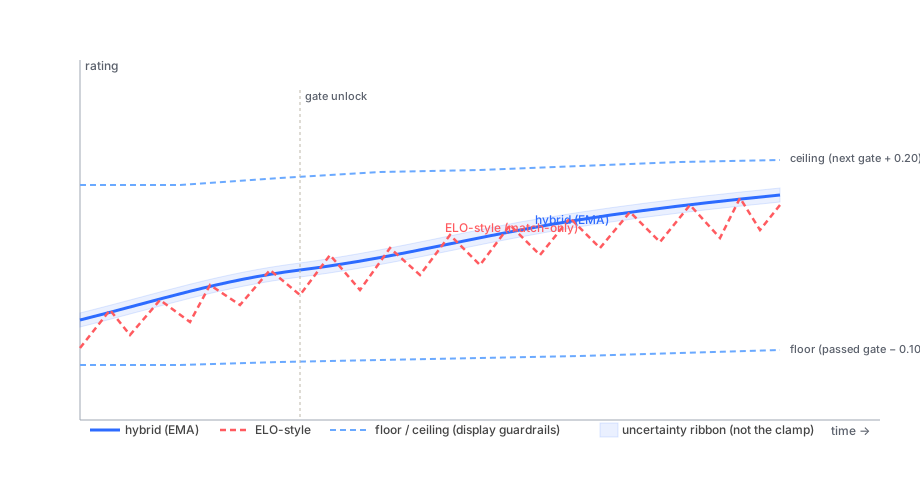
caption: rating vs. time — session scores (points), EMA (smooth line), clamp range (shaded band)
What you’ll see in the app
- Results: “This session: 9/10 (90%). PIQ estimate: 3.62 ± 0.08.”
- Start: a compact chip with your current PIQ and the next-gate CTA. No math dump.
- Unlocks: still binary. Pass the gate, move on. Rating never blocks eligibility.
Why not pure ELO (or pure gates)?
Pure ELO treats points like perfect witnesses. They’re not.
Pure gates ignore momentum between thresholds.
The hybrid keeps the skill signal (you vs. clean scenarios) and layers time-weighted memory so progress looks like a trend, not a coin flip.
Practical upside
- Trust: Pass a gate without fearing a visual demotion tomorrow.
- Coaching: Decimals show where you are inside the tier—great for targeting drills.
- Transparency: Parameters (weights, floors) are simple and auditable. No black box.
Pro tip: Track your last 5–10 sessions. If the band is shrinking and the mean creeps +0.03–0.05 per session, you’re on a healthy ramp.
Where pure ELO goes sideways
| scenario | pure ELO reaction | hybrid reaction | why it matters |
|---|---|---|---|
| Barely pass a new gate | Tiny bump; may still sit below the new tier | Clamp shows you just under the unlocked gate; continuous score sits inside the tier | You see progress without a fake demotion |
| Strong pass with low prior | Big jump; can overshoot | Modest rise; session tops out ~+0.20 over gate; EMA blends | Rewards quality without flinging you a full tier |
| Fail slightly above level | Drops on a narrow loss | Session dips toward lower half-step; EMA softens the hit | “Failing up” isn’t punished |
| Small-sample pass (5–6 items) | Large variance; one result swings rating | Wide visible band; damped EMA weight until sample grows | UI says early data instead of pretending precision |
| Two fails right after unlocking | Yo-yo risk; erases gains | Floor lowers slowly (hysteresis) after repeated fails | Stability reduces fear of testing up |
| Long gap + one hot session | Big spike with high K/recency | Time weighting bumps α a bit; EMA + clamp keep it sane | Comebacks feel earned, not lucky |
Data that shaped the defaults
In early tests, a 10-question gate, EMA α ≈ 0.25, and a floor at gate − 0.10 felt right.
Strong passes (≥ 90%) nudged the floor to gate − 0.05.
After two consecutive fails at the new gate, the floor eased down ~0.05.
Players called it honest—steady, not sticky.
Takeaway
Ratings should teach, not tease.
Continuous scores show where you stand.
EMA remembers the grind.
The clamp respects your wins.
Keep drilling. The number will follow your reps.